Questions and Answers
What residents have asked about the project, by topic, with our current answers.
112 questions residents have asked at meetings, by email, and on this website, grouped by topic. Search, or jump to a topic. Can't find yours? Ask us.
Every original question and earlier written response is kept in the question history.
Most asked
- Where will firefighters get water? Will there be a fire pond?
- Will my well be tested, and who pays if it changes?
- What will the sound study measure?
- What about wildlife and habitat?
- What does Charlton actually get?
- Who pays to remove the batteries and restore the site?
- Is this going ahead whether we like it or not? How do we stop it?
- Charlton already has solar, a power plant, gas storage. Why add this?
Fire safety 21 questions
Can you guarantee a battery fire will not happen?
No. Batteries can overheat in a chain reaction called thermal runaway. Early projects, built with older designs and chemistries before current fire standards, had more problems. The Electric Power Research Institute keeps a public database of failures at battery sites. It shows failures per unit of energy installed fell 98 percent between 2018 and 2025, and EPRI finds the yearly failure rate of a battery unit comparable to that of large utility transformers. The batteries proposed here use lithium iron phosphate, which has no cobalt or nickel. That chemistry is safer, not safe. EPRI's database lists no U.S. fire at a Tesla Megapack recorded as lithium iron phosphate: the U.S. Megapack fires it lists used nickel-based (NMC) cells, and two other Tesla incidents do not list a chemistry. Tesla's data sheet says the Megapack 3 is designed to meet and exceed UL 9540A fire testing, and Tesla has not yet published its test report. Design and testing lower the risk, but they do not remove it. That is why the Emergency Action Plan matters.
Corrected November 17, 2026, from the earlier published response
How is the equipment tested for fire?
Battery systems are tested to UL 9540A, the standard test method for thermal runaway fire propagation. It runs at four levels: the cell, the module, the full unit, and the installed layout. In the larger tests, a fully loaded unit is forced into thermal runaway, and the neighboring units, placed at the real spacing, are monitored to confirm the fire does not spread to them. NFPA 855, the national standard for installing these systems, uses these test results to set requirements such as the spacing between units. The Megapack 2 and 2XL were tested this way, and the results are in the Fire Protection Engineering report in the Document Library. The test reports for the newer Megapack 3 are still being collected, and we will post them as they are released.
How long would a fire burn?
The most extreme fire test in the report on the Megapack 2 and 2XL, the earlier models, put a fully loaded unit into forced thermal runaway with its battery management and cooling systems turned off. Visible flames lasted 6 hours and 40 minutes, and flame intensity peaked about 60 to 90 minutes after flaming began. The fire burned about half of the one cabinet tested. No other cabinets were placed around it in that test. The report's fire modeling shows it would not spread to neighboring cabinets at the clearances studied. The unit was watched for several hours afterward, and no further fire was observed. The full report, Tesla Megapack 2/2XL Fire Protection Engineering (FPE) Report, is in the Document Library under Safety & Emergency Response: https://carpenterhillpower.com/documents
This project is planned to use the Megapack 3, and its test reports are still being collected, so burn-time figures for this site have not been published. The Emergency Action Plan, being built with Charlton Fire, is where the response is written down. An independent reviewer the town selects will check it.
Corrected November 17, 2026, from the earlier published response
Would firefighters just let it burn?
The response being planned is defensive: keep people back, protect the surroundings, and monitor the air while the unit burns out. It is not "doing nothing." Firefighters would work to keep the fire from reaching anything else. In the most extreme test on the Megapack 2 and 2XL, the fire burned out in the one cabinet tested, with no other cabinets placed around it. Whether fire spreads to neighboring cabinets comes from the report's fire modeling, not from that test.
A fire protection engineering report that Tesla commissioned on the Megapack 2 and 2XL found that hose lines are not needed to stop a fire spreading from one cabinet to the cabinets next to it at the spacing tested. In its large-scale fire test, no liquid runoff was seen during the fire or the cleanup afterward (page 32). Tesla has not yet published the equivalent report for the Megapack 3 planned here.
Tesla's emergency response guide for its Megapack products says to let the affected unit burn itself out, because water on the burning unit has little effect. It leaves water to the first responders' discretion: if they use it, Tesla recommends a fog pattern on nearby exposures. The guide says cooling down can take 12 to 48 hours or longer.
Corrected November 17, 2026, from the earlier published response
What about smoke and our lungs? How far would it go?
Smoke from a battery fire can contain carbon monoxide and hydrogen fluoride, and even small amounts of hydrogen fluoride can be harmful. It is a real hazard close to the fire, mainly for firefighters and anyone nearby.
What has been measured at other fires is reassuring but limited. A 2025 review of 35 U.S. battery storage fires found that where air was sampled, on site, off site and in nearby communities, no concentrations posed a public health concern. Fire & Risk Alliance, a fire engineering firm, prepared the review, and the American Clean Power Association, the industry trade group, paid for it. These were other sites with other equipment, so this does not tell us what would happen here. The review is in the Document Library (page 3): https://carpenterhillpower.com/files/acp-bess-fire-impacts-2025.pdf#page=3
We have committed to publish a gas plume analysis, which looks at where smoke and gas could travel. We have not published it yet, so we cannot tell you that any road or home would be unaffected.
Would smoke settle in a valley near homes?
Smoke from a battery fire is hot, so it tends to rise and mix with the air, and in open air it thins quickly. A 2025 review of U.S. battery storage fires found that gases were rapidly diluted in open air, and that air sampling beyond the fire scene found nothing that posed a public health risk. The American Clean Power Association, the industry trade group, paid for that review, and it covers other sites with other equipment. The review is in the Document Library (pages 3 and 5): https://carpenterhillpower.com/files/acp-bess-fire-impacts-2025.pdf#page=5
Hills between the site and a road do not stop wind-blown smoke. Where smoke goes depends on wind and weather. The plan is to monitor the air while a unit burns out. The gas plume analysis is the study that answers this for the ground around this site. It is a published commitment, it has not been done yet, and it needs to account for the ground between the site and nearby roads.
Is there an evacuation plan? What about Route 20 backups?
The Emergency Action Plan is where evacuation and shelter-in-place decisions belong. It is not published yet. Residents raised two specific problems at the public meeting: Route 20 backups on holidays and in snow that could slow fire trucks from other towns, and narrow rural roads with one way out. We wrote both down for the plan.
Can Charlton's fire department respond?
The consolidated answer is being reviewed. Earlier responses remain available in the submission history.
Is fire equipment and training a benefit, or a project cost?
The project pays for fire equipment and training, not the town. The draft Community Benefits Plan lists them as a benefit, card 3.1. The plan is still a draft, so it is not a final commitment yet.
Corrected November 17, 2026, from the earlier published response
Where will firefighters get water? Will there be a fire pond?
A fire protection engineering report that Tesla commissioned on the Megapack 2 and 2XL found that hose lines are not needed to stop a fire spreading from one cabinet to the cabinets next to it at the spacing tested. Tesla has not yet published the equivalent report for the Megapack 3 planned here. Tesla's emergency response guide for its Megapack products says to let the affected unit burn itself out, because water on the burning unit has little effect. It leaves water to the first responders' discretion: if they use it, Tesla recommends a fog pattern on nearby exposures. The guide says cooling down can take 12 to 48 hours or longer. Extending town water is not part of the draft Community Benefits Plan. The planned response to a battery unit fire is also defensive: protect the surroundings and monitor the air while the unit burns out.
Corrected November 17, 2026, from the earlier published response
How will a lightning strike be kept from causing a fire?
On lightning strike mitigation: The site will have lightning protection built to NFPA 780, the national standard for lightning protection systems. That standard covers the equipment that gives a strike a safe path to the ground, such as air terminals, grounding, and surge protection. ESA has also committed to a lightning transient analysis, an engineering study of how the electrical surge from a strike would travel through the site's grounding and equipment. The results have not been published yet.
On fire-water runoff containment: The response being planned is defensive: keep people back, protect the surroundings, and monitor the air while the unit burns out. A fire protection engineering report that Tesla commissioned on the Megapack 2 and 2XL found that hose lines are not needed to stop a fire spreading from one cabinet to the cabinets next to it at the spacing tested. In its large-scale fire test, no liquid runoff was seen during the fire or the cleanup afterward (page 32). Tesla has not yet published the equivalent report for the Megapack 3 planned here. Tesla's emergency response guide for its Megapack products says to let the affected unit burn itself out, because water on the burning unit has little effect. It leaves water to the first responders' discretion: if they use it, Tesla recommends a fog pattern on nearby exposures. The guide says cooling down can take 12 to 48 hours or longer. Runoff along the southern boundary is to be captured.
Corrected November 17, 2026, from the earlier published response
What substances could be released in a fire or failure?
A damaged battery could vent hydrogen, carbon monoxide, and other hydrocarbons, along with smaller amounts of hydrogen fluoride and related fluorinated compounds from the electrolyte and binder. The facility's LFP chemistry does not contain cobalt or nickel, but that does not remove this risk, since it originates in a different part of the cell. A damaged transformer could release its dielectric oil, typically mineral or synthetic ester and not PCB-containing in modern equipment. Damaged cooling equipment could release glycol coolant or a fluorinated refrigerant. In the large-scale fire test in a fire protection engineering report that Tesla commissioned on the Megapack 2 and 2XL, no liquid runoff was seen during the fire or the cleanup afterward.
Corrected November 17, 2026, from the earlier published response
Vent panels, water inside the cabinet, sensor power
1) if there is a "gasket" issue with the deflagration panels does the deflection system redirect stormwater down inside or outside of the cab and are there sensors monitoring for water infiltration?
In the newer Tesla Megapack 3 design, the explosion vents sit in the doors with internal diverters, so water that gets in runs down the inside of the door and not onto the battery modules. Whether the units have dedicated water-intrusion sensors has not been published. Final equipment details will be confirmed in the plans filed with the state.
Corrected November 17, 2026, from the earlier published response
2) if there is this type of runoff thru the cabs where does that water go? Is it possible it could have toxins in it? Is it captured and disposed of somehow?
A fire protection engineering report that Tesla commissioned on the Megapack 2 and 2XL found that hose lines are not needed to stop a fire spreading from one cabinet to the cabinets next to it at the spacing tested. In its large-scale fire test, no liquid runoff was seen during the fire or the cleanup afterward (page 32). Tesla has not yet published the equivalent report for the Megapack 3 planned here. Tesla's emergency response guide for its Megapack products says to let the affected unit burn itself out, because water on the burning unit has little effect. It leaves water to the first responders' discretion: if they use it, Tesla recommends a fog pattern on nearby exposures. The guide says cooling down can take 12 to 48 hours or longer.
Corrected November 17, 2026, from the earlier published response
3) how are sensors powered? if they need AC power how is monitoring done during an incident?
How the sensors are powered, and what backup power supports them, has not been published and is an open item in the Emergency Action Plan. The design is passive in a fire: UL 9540A fire testing checks that neighboring units stay within a safe temperature range through insulation alone, without power or air conditioning. Responders are to have real-time temperature data from a 24-hour network operations center and a local command center.
Website and email draft; source answers as of October 7, 2026
4) how is wind driven rain or snow kept out in an incident with the panels open?
The cabinets are built for outdoor use. In the newer design the explosion vents are in the doors with diverters, so rain or snow that enters is directed down the inside of the door and away from the electronics. Tesla's data sheet rates the main enclosure IP66, which covers dust and hose-directed water. Final equipment details will be confirmed in the plans filed with the state.
Corrected November 17, 2026, from the earlier published response
Why not put the batteries in a building with filters?
No, and we avoid doing this because enclosing batteries in buildings increases safety risks. Historically, the 2019 explosion in Surprise, Arizona, showed that sealed structures allow flammable gases to accumulate, causing a backdraft when opened. More recently, building-housed fires at Otay Mesa (May 2024) and Moss Landing (January 2025) demonstrated that even with ventilation, buildings trap extreme heat, accelerate cascading runaway between racks, and block direct firefighter access, prolonging the fires for days. The outdoor cabinet design is meant to vent gas and heat to open air rather than trap them, and it is designed to keep a fire in the cabinet where it starts. It also gives responders access from every side.
Corrected November 17, 2026, from the earlier published response
What about the fires in California and elsewhere?
The design uses four layers of safety. First, the batteries use lithium iron phosphate, which has no cobalt or nickel and is less prone to thermal runaway than nickel-based chemistries. That chemistry is safer, not safe. Second, Tesla's data sheet says the Megapack 3 is designed to meet and exceed UL 9540A fire testing, and Tesla has not yet published its test report. Third, the equipment sits approximately 500 feet from the nearest residential building, which is the landowner's own home. Fourth, we are drafting a community-specific Emergency Action Plan with Charlton Fire. The response being planned is defensive: keep people back, protect the surroundings, and monitor the air while the unit burns out. Recordings of the two fire safety sessions are posted in the engagement log.
Corrected November 17, 2026, from the earlier published response
What if someone shoots it?
The steel enclosure has an IP66/NEMA 3R weather rating to prevent dust and water ingress, but it is not armored. A gunshot will likely pierce the skin. If a puncture breaches the cells, it triggers an internal short. This initiates a sequence identical to a standard internal cell defect. The Battery Management System automatically isolates the unit, and standard site safety protocols manage the response. We address physical security threats through site-hardening measures, including secure perimeter fencing, 24/7 camera monitoring, setbacks, and vehicle barrier bollards.
How far apart and how thick are the cabinets?
Spacing follows Tesla's installation clearances. In the fire protection engineering report Tesla commissioned on the Megapack 2 and 2XL, the tested clearances were 8 feet in front, 6 inches behind, and 6 inches to the sides. Beyond these unit-to-unit clearances, the outer perimeter fence sits approximately 50 feet away from the battery layout, with a 26-foot access road running inside the fence to accommodate emergency and maintenance vehicles.
Corrected November 17, 2026, from the earlier published response
Is money set aside for residents if a fire causes damage? Will my insurance go up?
Budget and direct aid. Carpenter Hill Power will maintain liability insurance for the project. The project is still in preliminary development, so coverage limits and policy details have not been finalized and no dollar amount can be given. There is currently no separate budget for direct resident relief outside applicable insurance coverage or government programs. Obligations and available resources would depend on the circumstances of an incident, the applicable insurance policies, and the legal requirements in effect at the time. The draft Community Benefits Plan proposes an incident escrow: money held by a third party that the town can draw on for its emergency response costs and for cleanup after an incident at the site. The amount is not set yet. The draft plan also proposes additional protections for close neighbors within 1,000 feet of the work limit, including well testing and property value protection. Those are drafts and not yet commitments.
Insurance rates. ESA is not aware of evidence that proximity to a battery energy storage facility, by itself, raises residential insurance premiums. Homeowners' rates are generally based on factors specific to the property, such as construction, age, claims history, and proximity to emergency services.
Corrected November 17, 2026, from the earlier published response
Will the emergency plan be independently reviewed and public?
Yes, independent review is committed, with the reviewer selected by the town and paid for by us. The plan is being completed with the fire department before we file, and the state review that follows is public and formal.
Website and email draft; source answers as of October 7, 2026
One equipment maker, a U.S. supplier, testing the whole site?
These were specific asks from a Planning Board member, and they are on our list. We told the committee member that testing the whole site as a system is best practice and should be in the plan. A site this size uses equipment from more than one maker, so one brand throughout is not realistic. The aim is the best and safest equipment for each part. None of this is a commitment yet.
Corrected November 17, 2026, from the earlier published response
Could a different design or battery type (sodium-ion) reduce risk?
Since July, we have looked at two ways. One is moving the equipment on the site, which has mostly not worked for several reasons. The other is a different technology. Lithium iron phosphate batteries have improved: EPRI finds the yearly failure rate of a battery unit is now comparable to that of large utility transformers. Sodium-ion batteries are still very new, and most claims about their safety have not been tested in operating systems. Any change in the battery technology would have to go back through approvals. Nothing is decided.
Corrected November 17, 2026, from the earlier published response
Water, wells, and runoff 14 questions
Will the project contaminate my well? Wells within a mile?
No study yet answers this for a fire. We have committed to a groundwater monitoring program with terms in writing before construction starts, and to publish the hydrology and stormwater studies. A well inventory within one mile is complete, and a door-to-door survey within half a mile is next. If you rely on a private well, send us your road so we can check it against the site plans, and we add wells to our list each time someone notifies us.
How will firefighting water be kept out of wells?
A fire protection engineering report that Tesla commissioned on the Megapack 2 and 2XL found that hose lines are not needed to stop a fire spreading from one cabinet to the cabinets next to it at the spacing tested. In its large-scale fire test, no liquid runoff was seen during the fire or the cleanup afterward (page 32). Tesla has not yet published the equivalent report for the Megapack 3 planned here. Tesla's emergency response guide for its Megapack products says to let the affected unit burn itself out, because water on the burning unit has little effect. It leaves water to the first responders' discretion: if they use it, Tesla recommends a fog pattern on nearby exposures. The guide says cooling down can take 12 to 48 hours or longer. Separately, runoff along the southern boundary will be captured. The Emergency Action Plan being developed with the Charlton Fire Department will also be examined by a reviewer the town selects, at no cost to the town.
Corrected November 17, 2026, from the earlier published response
How many private wells are near the site?
The state's well database holds 87 records within about a mile of the site. Seventy-one of them can be placed on a map. Sixteen records on Carpenter Hill Road carry no street number and cannot be placed. A screen of how water runs over the land surface puts two domestic wells on T. Hall Road, 0.39 and 0.45 mile away, downhill in the pad's own drainage. That screen follows the land surface, not groundwater moving through bedrock, and it does not say whether any well would be affected. The details are in section 6.5 of the September 10 engagement packet, page 77: https://carpenterhillpower.com/files/carpenter-hill-dpp-packet-2026-09-10.pdf#page=77
The hydrogeologic study includes the well inventory, and the published study will include the counts and mapping requested. As of that packet, the door-to-door well survey within half a mile had not started.
Will my well be tested, and who pays if it changes?
Will baseline testing be performed on surrounding private wells before construction?
The draft Community Benefits Plan proposes that the project pay to test every eligible private well within 1,000 feet of the work limit before construction, so each household has a baseline. Wells downhill of the site on T. Hall Road and any well the Board of Health identifies as downgradient are also covered. Testing would repeat once during construction and once within 12 months after construction ends. After that, wells would be tested on a routine schedule that the Board of Health sets, paid for by the project up to a cost cap that is not set yet, and again after any incident on the site or blasting near a well. The plan is a draft, and well testing is among its open decisions.
If a resident's well becomes contaminated or unusable, who pays immediately for testing, bottled water, treatment, or replacement of the water supply?
If a well were affected, the draft Community Benefits Plan proposes that the project pay for bottled water within 48 hours and for treatment or a replacement well if a test shows a change linked to the site. This is a draft and not yet a commitment. Separately, if oil or a hazardous material reached a drinking water well serving a home, Massachusetts cleanup rules presume that the immediate response must stop or reduce that exposure, and they list a temporary alternative water supply as one way to do it (310 CMR 40.0414). Those rules do not set a number of hours. The 48-hour timeline is the draft plan's own. The project is also to carry pollution liability insurance during construction and operation, and under Massachusetts law cleanup responsibility for contamination rests with the site's owner, regardless of fault. The emergency response plan defines how a release would be contained and addressed.
What legal protection exists if contamination shows up years later or after a sale?
What legally enforceable financial protection will exist if contamination is discovered years later or after the project changes ownership?
Contamination found later, including after a sale, falls under the state's existing cleanup law, M.G.L. c. 21E. It makes the current owner and operator of a site, and anyone who owned or operated it when a release happened, responsible for the cleanup.
Corrected November 17, 2026, from the earlier published response
What responsibilities continue if contamination is discovered after the facility closes?
Environmental liability under Massachusetts law does not end when a facility closes: the same state cleanup law applies. The draft Community Benefits Plan does not yet say how contamination found after closure would be handled. It calls for a full review, before decommissioning begins, of what happens to any commitments still running.
Corrected November 17, 2026, from the earlier published response
Will the facility use local water or change the water table?
Carpenter Hill Power is a battery storage facility, not a power plant that needs a continuous supply of water to generate electricity. Each battery unit has its own liquid cooling system. The project is not expected to need an ongoing supply from Charlton's drinking water system for normal operation. Cooling and water use details have not been published. The hydrology and stormwater studies are committed and will be published, and a groundwater monitoring program is committed.
Website and email draft; source answers as of October 7, 2026
Has a hydrogeologic study been done?
Not yet. The hydrogeologic study is committed and underway, and it will be published when it is complete. A well inventory within one mile is complete, and a door-to-door survey within half a mile is next.
Why present the project before the studies are done?
Engagement is happening before the studies finish so that residents' questions can shape what the studies examine, rather than arrive after the fact.
Will clearing trees make flooding worse? How much water does an acre hold?
Trees slow and store water during a storm. Part of the area is already inside National Grid's easement. We have committed to no net increase in runoff and to no wetland fill beyond what state permits allow. Soils on the site drain poorly, so water tends to run across the surface, and water also flows onto the site from the north. The stormwater basin layout is still being designed. We have not published the engineering numbers. Our mapping shows rain that lands on the equipment area draining south into a chain of wetlands. That covers surface water only. It does not tell us about groundwater.
Corrected November 17, 2026, from the earlier published response
Will you contain all of the site's runoff, with a liner?
Containing all of the site's runoff would have to be part of the filing. Staff also said we could show it in the site plan sooner. Runoff along the southern boundary is a commitment to capture. Whether the site needs a full liner is an engineering question for a geotechnical survey and is not answered here.
Corrected November 17, 2026, from the earlier published response
How close is it to Cady Brook?
Our mapping shows rain that lands on the equipment area draining south into a chain of wetlands, not into Cady Brook. A detailed project location map and a preliminary wetlands index are in the Document Library. State reviewers have asked for a formal wetland delineation during design.
For exact distances, reach out directly: jsantiago@esa-solar.com or 407-232-7440 ext. 251.
Existing FAQ draft; source answers as of October 2026
Will there be blasting, and could it affect my well?
It has not been decided whether blasting is needed. There is ledge on both sides of the site, and how much rock the work would meet will come from test borings. Rock can sometimes be removed by hammering or ripping instead of blasting, and that choice is made in the construction plan. If blasting is needed, state rules limit when it can happen, how long each blast lasts, and how much force is used. Blasting can send vibration through rock, and how far that matters depends on the amount of rock removed, the distance to a well, and the local geology. No study yet shows whether any well would be affected.
The draft Community Benefits Plan proposes testing private wells within 1,000 feet of the work limit, plus wells on T. Hall Road, at the project's cost before construction. Those wells would be tested again after any blasting near a well. If a test shows a change linked to the site, the project would pay for bottled water within 48 hours, then for treatment or a replacement well. The draft is not final. Separately, if oil or a hazardous material reached a drinking water well serving a home, state cleanup rules presume that the immediate response must stop or reduce that exposure, which can include a temporary alternative water supply (310 CMR 40.0414). Those rules do not set a number of hours.
Wells about a mile from the site are outside that distance. The hydrogeologic study and the well survey are meant to show which wells need to be part of this work, and their results are not published. If you rely on a private well, send us your road and we will check it against the site plans and the well records.
Is the old gas station spill related to this project?
No. That spill is a different location and is not in the area this project is part of. We are sorry that your well was affected.
How can I ask about conditions at my own property?
This needs an individual response based on the original message and the circumstances of the property or person.
Noise 8 questions
How loud will it be?
The state noise policy sets the limit. Sound from the facility may not be more than 10 decibels above the existing background sound at the property line and at the nearest homes. Meeting that limit is a condition of the state permit, and it binds any owner. The closest dwelling to the equipment is the home of the landowner who is leasing the site to the project. A first screening used stand-in equipment data, because sound data for the Megapack 3 is not available yet. That analysis has since been refined and will be re-run, so its results may change. The project plans to build a sound wall on one side of the site. The full sound study will measure background sound at nearby homes and predict the sound level at each. It will be published, and its results, not the screening, set the design. Decibel figures mentioned at the meeting came from preliminary data and varied. The figures to rely on will come from the full study.
Corrected November 17, 2026, from the earlier published response
Where does the noise come from?
Three sources: the cooling heat pump in each battery unit, the inverters that convert the electricity, and the transformers that raise the voltage. The cooling and inverters are in each battery unit. The transformer sits in a shared medium-voltage assembly.
Corrected November 17, 2026, from the earlier published response
Will it run at night?
Yes, this equipment can operate at night. Cooling runs according to battery needs, charging and discharging follow grid demand, and transformers remain energized continuously. This is why nighttime modeling and nighttime limits are part of the study and the permit conditions.
Website and email draft; source answers as of October 7, 2026
What will the sound study measure?
What are the predicted sound levels at every nearby residence during maximum operation, including tonal and low-frequency sound?
This is what the sound study will produce: predicted levels, home by home, under maximum operating conditions, including tonal character, low-frequency sound, and worst-case rather than average conditions. The study's scope is set by the acoustic professionals conducting it.
Corrected November 17, 2026, from the earlier published response
What are the existing daytime and nighttime background sound levels at the nearest homes?
Measured background levels are the foundation of the sound study, which is committed and in progress. They will be presented in the published study rather than stated in advance of it.
Website and email draft; source answers as of October 7, 2026
Will the study account for hills, seasonal loss of tree cover, wind, and nighttime temperature inversions?
These are standard inputs for an acoustic assessment of this kind, and the published study should address each of them. The study's scope is determined by the acoustic professionals conducting it.
Corrected November 17, 2026, from the earlier published response
Please provide a map showing modeled sound contours and every residence located within each contour.
A sound contour map showing residences is a standard output of a professional acoustic assessment, and the published study is expected to include one.
Website and email draft; source answers as of October 7, 2026
What is the predicted increase over existing background sound at the nearest homes and at each distance?
Increase over background is the appropriate measure, and it requires the measured baseline first. Both the baseline and the resulting increase, home by home, will be included in the published study.
Website and email draft; source answers as of October 7, 2026
Will the analysis separately evaluate tonal humming, low-frequency sound, vibration, and maximum operating conditions, not merely an average dBA level?
Tonal character, low-frequency sound, vibration, and maximum-condition analysis are standard elements of an acoustic assessment for a facility of this kind, and we expect the published study to address each. An average alone can understate what a resident experiences at specific times, such as at night, so the study needs to go beyond averages to answer that question.
Website and email draft; source answers as of October 7, 2026
Will it account for the way sound may travel across elevated terrain, through areas with limited natural barriers, during winter when trees have no leaves, and under nighttime temperature inversions?
These are recognized inputs to an acoustic assessment, and the published study should address each condition or explain why not. The scope itself remains with the professionals conducting the study.
Corrected November 17, 2026, from the earlier published response
Will measurements be taken at elevated residences and other locations that may have a direct line of sight to the facility, rather than only at the project property line?
Measuring only at the property line would not answer what residents will actually hear at home, so measurement locations need to reflect that. Choosing specific measurement locations is a decision for the acoustic professionals, but the published study will state where measurements were taken and why.
Website and email draft; source answers as of October 7, 2026
What noise limit applies, and who enforces it?
What enforceable noise limit will apply, and what happens if residents experience humming or vibration after operation begins?
Enforceable noise limits are set as permit conditions in the state siting process, informed by Massachusetts noise policy. They bind whoever owns the facility and are enforced by regulators. A structured post-construction review is a standing plan topic, since residents have said commitments need to be checked after construction is complete.
Corrected November 17, 2026, from the earlier published response
Who will independently investigate complaints after the facility begins operating?
Noise complaints are handled under the state requirement: the limits are conditions of the state permit, enforced by regulators against whoever owns the facility.
Corrected November 17, 2026, from the earlier published response
If the actual noise is greater or more disruptive than modeled, what corrective measures will be mandatory, and who will enforce them?
If operation exceeds permit-condition limits, compliance is mandatory and enforced by the permitting authorities against whoever owns the facility at the time. Noise that remains within limits but is still disruptive is a separate question, addressed through the plan's neighbor-protection and post-construction review items rather than through the permit alone.
Website and email draft; source answers as of October 7, 2026
Will operations be reduced or stopped if sound limits are repeatedly exceeded?
Limits on how the facility operates come from the state requirement, through the noise conditions in the state permit. You can raise concerns about them during the plan comment period and the state review.
Corrected November 17, 2026, from the earlier published response
Can you build a sound barrier now?
Residents pointed to another town's storage project that has a sound barrier built in. This has been recorded as feedback. The project plans to build a sound wall on one side of the site. The draft Community Benefits Plan names a sound wall as the first fix if sound measured at neighbors' property lines after the facility starts operating does not pass the check against the sound study and the state limit.
Corrected November 17, 2026, from the earlier published response
What about construction noise and trucks?
Construction is temporary, about 12 to 18 months, during the day. We will plan truck routes with the town.
The 'light rainfall' comparison understates it.
The rainfall comparison describes loudness, offered because a decibel number alone means little to most people without a familiar reference. It does not describe duration, and duration is what matters most to someone living near a continuous source. The facility can produce sound at night. Predicted levels at the nearest homes will come from the sound study that is now in progress.
Website and email draft; source answers as of October 7, 2026
Land, wildlife, and property 6 questions
Will property values go down?
The draft Community Benefits Plan proposes that if a home within 1,000 feet of the work limit sells for less than an independent appraisal says it is worth without the facility, the project pays the difference, up to a cap that is still to be set, for five years after commercial operation. The program is backed by a fund. The size of the fund, and when it is set aside, are open decisions in the draft. This is a draft and not yet a commitment. Separately, the project has offered a property value study by a Massachusetts-licensed appraiser, comparing properties near comparable operating projects with similar properties farther away, published so residents can review the evidence directly.
Will it change the rural character, views, and quiet?
The project is industrial equipment on a rural parcel. The design keeps clearing outside the transmission right-of-way to no more than 10 acres of a 47-acre parcel, keeps equipment under 10 feet tall and set back from homes, and keeps existing trees for screening where possible. Close-neighbor protections, including screening, noise, and night sky, are Community Benefits Plan topics under discussion. Comments on the draft plan are open into 2027.
Website and email draft; source answers as of October 7, 2026
What about wildlife and habitat?
The current design limits clearing outside the transmission right-of-way to no more than 10 acres of the 47-acre parcel, and the fenced battery area is about 5 acres or less. Existing vegetation is to be kept where possible and used to screen the facility. State reviewers have asked for a formal wetland delineation and a formal information request on rare species during design. A full wildlife and habitat plan has not been published.
Replanting to offset the acres the project clears is required mitigation (page 21). Habitat restoration, additional replanting, additional screening, and a conservation fund are Community Benefits Plan topics. They are under discussion and are not promised yet. The draft proposes an additional replanting target in acres, on top of the replanting the permit requires. The number of acres is not set yet. ESA has not committed to specific programs or funding amounts before hearing from Charlton about what would be most valuable, and the project is looking at opportunities to work with local conservation organizations. The decommissioning bond, required before construction, covers restoration so it does not fall to the town or residents.
Corrected November 17, 2026, from the earlier published response
What will construction do to the land and roads?
Construction is temporary, with limited truck traffic, restricted work hours, and a defined duration. We have committed to control erosion, to clear no more than 10 acres of trees outside National Grid's transmission right-of-way, and to plan construction traffic with the town.
Corrected November 17, 2026, from the earlier published response
How many homes are within a quarter mile, half mile, mile?
A complete written answer is not available yet.
Are there comparable facilities with 10 years of history?
Few grid-scale lithium battery facilities anywhere have ten years of operating history, since the industry at this scale is younger than that. Agreements from other Massachusetts battery projects, including Carver's planned 150 MW Cranberry Point project, are already in our public document library, along with safety and incident data from the national fleet. We are compiling additional comparable-project materials residents have requested, including items submitted by committee members. The property value study described in the property value answers uses matched pairs of homes near operating projects and is the strongest evidence available on that question.
Corrected November 17, 2026, from the earlier published response
What Charlton gets 14 questions
What does Charlton actually get?
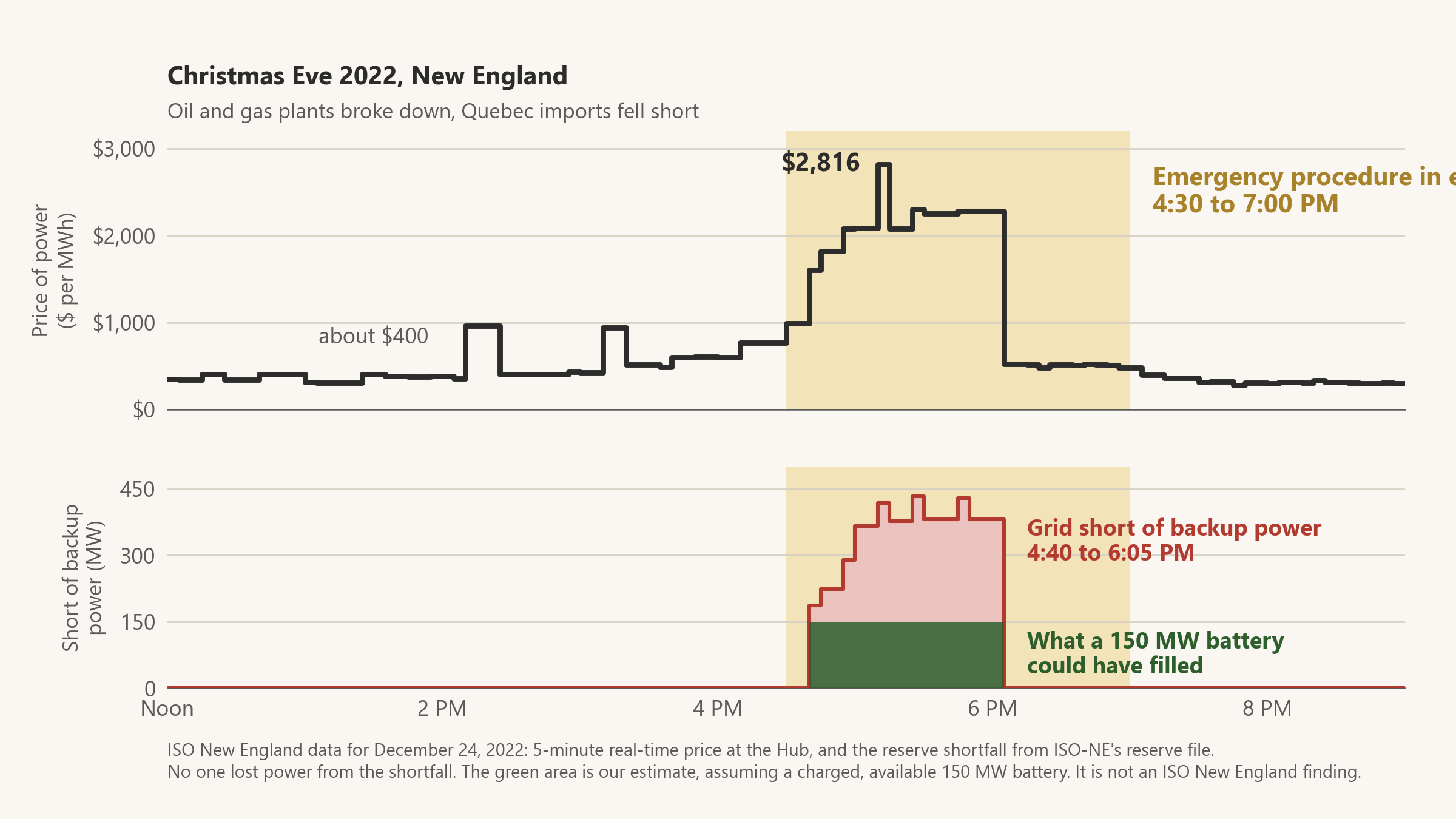
Charlton does not get four hours of backup power from the facility. A battery storage facility is not a backup generator for the town or for homes. It connects to the regional grid, stores power when there is plenty, and returns it when supply is tight, such as at peak demand on a winter day or during a major storm like Christmas Eve 2022, when the regional grid operator held the grid through generator outages and lost imports. The US EPA describes battery storage the same way: it stabilizes the electrical grid and keeps power flowing to homes and businesses. That helps keep the transmission lines that meet next to the site, and the lines across Massachusetts and beyond, running reliably, which benefits Worcester, Charlton, and the surrounding towns that rely on them.
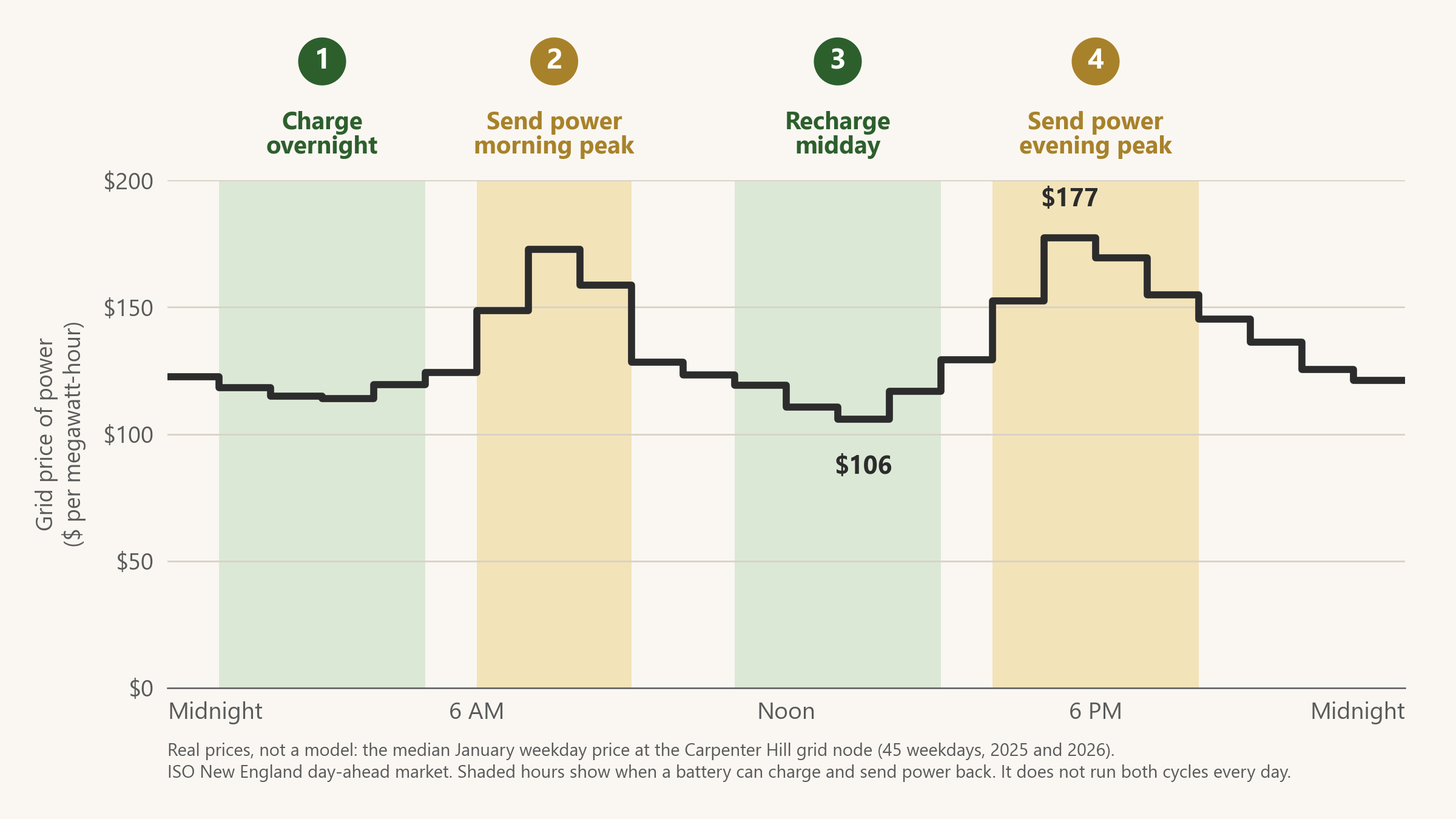
For hosting the facility, Charlton gets yearly payments: property tax, or a payment in lieu of taxes (PILOT), plus additional funds negotiated with the project, as other towns have done, for example Medway's PILOT and host community agreement. Protections the facility needs, such as fire equipment and training and well testing, come out of that total first, and the rest goes into one fund the Select Board controls. The draft Community Benefits Plan sets out what the town and residents have asked for, and comments are open into 2027.
What is a PILOT, and why use one?
PILOT stands for payment in lieu of taxes. A battery project loses value on paper as the equipment ages, so ordinary property taxes shrink over time. A PILOT sets a predictable payment each year instead. Developers like it for the same reason towns do: both know what to expect. For Charlton, the draft Community Benefits Plan names the Select Board and the Board of Assessors as negotiating it with the project owner. Other towns have agreed to 20-year terms.
Corrected November 17, 2026, from the earlier published response
How much would Charlton receive?
We do not have a Charlton figure. Three Massachusetts agreements shown at the meeting, in Carver, Revere, and Medway, work out to roughly $9,300 to $11,300 per megawatt per year. Chelsea is not included because its signed agreements are not public. That range is only for context, and it is not a promise or an estimate for Charlton. Our tax and assessment research is still open.
Corrected November 17, 2026, from the earlier published response
Will my electric bill go down?
We have not promised any share of a household's electric bill. Rising electricity prices are a national trend driven by higher demand. Charlton buys power in bulk, so a benefit tied to bills would have to be negotiated with the town and with National Grid. The draft Community Benefits Plan names that route as an open question to explore. At the public meeting this was raised as one idea. Nothing is agreed.
Where does the power go in a blackout? Will it back up my home?
The regional grid operator decides, not ESA and not the state, and electricity goes to the nearest demand. The project is built to support the grid as a whole. It is not built to back up individual homes.
Who enforces the Community Benefits Plan?
The state does not enforce it, and the plan itself is not legally binding. What binds the owner is the permit conditions, any agreement the town and the project sign, and the decommissioning bond (page 35). We are discussing putting some items into a community benefit agreement between the owner and the town, which would be legally binding on the owner. The town is free to write its own agreement.
Corrected November 17, 2026, from the earlier published response
Will the plan go to Town Meeting?
The state does not require it. The draft plan schedules a Citizen Advisory Committee meeting on December 10, 2026, to go over the comments received and how the plan responds to them.
Corrected November 17, 2026, from the earlier published response
What about the ideas residents proposed?
Residents proposed solar and batteries for the senior center and the police and fire stations, ongoing well testing, an escrow for takedown and failures, property value protection, extending town water lines, and replanting 15 acres of trees elsewhere in Charlton. Others asked for an enforcement escrow, help for the town with negotiating, a sound wall, cleanup of the old mill and gas station on Route 20, and free electric vehicle charging.
The draft Community Benefits Plan takes them in this way:
- Solar and batteries at town buildings become an eligible use of the town's benefit fund, which the Select Board controls.
- Wells get routine testing on a schedule the Board of Health sets.
- An incident escrow and an enforcement fund are proposed.
- The bond terms are written into the plan.
- When the property value fund is set aside is listed as an open decision.
- Extending town water lines is not part of the plan.
- A tree replanting target in acres is proposed.
- A sound wall is named as the first fix if a sound check fails.
- The project would pay for the town's own independent review of the site studies and of a benefits agreement.
- Electric vehicle charging is listed as raised, with no commitment.
- The Route 20 cleanup is not part of this project and is not in the plan.
Amounts are not set yet.
Where are the results of the benefits activity?
Residents in the 12:30 PM session picked their top benefit topics by phone. Money for the town budget drew the most picks, followed by fire equipment and training, conservation land and habitat, and help with home energy costs. The full results are in the session summaries at carpenterhillpower.com/documents/public-forum-sept-30-summary. In the 6:30 PM session, the first activity opened on phones only in the last few minutes before the close. Two people answered: conservation land and habitat and help with home energy costs drew 2 picks each, and money for the town budget drew 1. No paper ballots were turned in, and there was no time for the points round. The activity is advisory only. It is not a budget and not a commitment.
Will local people and businesses be hired?
Local hiring and businesses. Local hiring and the use of local businesses are Community Benefits Plan topics, and no commitment has been made yet. ESA has met with the MassHire Central Region Workforce Board and Bay Path Regional Vocational School about workforce development and employment. ESA is exploring ways to work with local contractors, tradespeople, suppliers, and service providers during construction and, where appropriate, over the life of the facility. Residents are invited to say what they would consider a meaningful local hiring commitment.
Conservation groups. The draft plan proposes conservation funding beyond the replanting the permit requires (card 3.7). Amounts are not set yet.
Oversight board. The Citizen Advisory Committee is open to anyone who accepts the responsibilities in its charter, meets regularly, and posts its materials and notes. Its charter and roster are published in the Document Library. The draft plan proposes keeping the committee open for the life of the facility, with an annual public review of what was delivered.
Defining community needs. Residents, the committee, town boards, and state reviewers can all raise them, and the Community Benefits Plan process shapes them. The Select Board decides how the town fund is used, and the town and the project decide together which items go into a signed agreement.
Corrected November 17, 2026, from the earlier published response
Who decides what the town needs? Will a resident board oversee it?
Residents and the town shape the plan through the state's pre-filing process. People raise concerns and name what Charlton and its residents need, at public meetings and office hours, Citizen Advisory Committee meetings, and in written comments, and those go into the draft Community Benefits Plan. The town and residents then comment on the draft to decide which items come first.
Some protections come first because of what the facility is, such as fire safety equipment and training. Beyond those, the town and residents decide what else Charlton needs. The more people take part, the closer the plan can get to a consensus, and hearing from the neighbors closest to the site is a priority.
The Select Board decides how the town fund is used, guided by public comments and the plan, and the town and the project decide together which items go into a signed agreement (page 26).
Updated response, November 19, 2026
Can the plan fund school STEM programs?
It is a great idea and has been shared with our team. School and training ideas are part of the conversation, including early talks with Bay Path about students in trades programs. Nothing is decided yet. Send your own ideas through the Participate page.
Existing FAQ draft; source answers as of October 2026
How do town revenues compare with the project's costs to Charlton?
The project's position is that costs the facility creates, including fire equipment and ongoing training, belong to the project, not the town. The draft Community Benefits Plan, section 3.1, proposes that the project owner pay directly for the equipment and training the Fire Chief identifies, plus an annual equipment and training allowance paid to the town. The amounts are not set yet: https://carpenterhillpower.com/files/carpenter-hill-community-benefits-plan-draft.pdf#page=14
We do not have a figure for what Charlton would receive, so a side-by-side comparison of town revenue and town costs has not been published.
Roughly how much could Charlton receive each year, and how could it be split?
What is the ballpark total?
This is an estimate for discussion. It is not a promise, not an offer, and not Charlton's number. We do not have a Charlton figure, and our tax and assessment research is still open. Three Massachusetts agreements, in Carver, Revere, and Medway, work out to roughly $9,300 to $11,300 per megawatt per year. At 150 megawatts, that range comes to about $1.4 to $1.7 million a year. The amount is the town's to negotiate. In this estimate it is one total: protections come off the top first, and what is left is the town fund.
How did other towns arrive at their amounts?
Each town negotiated its own deal. The $9,300 to $11,300 per megawatt range combines every yearly payment each town gets from its project, the PILOT plus any separate host community agreement, averaged over 20 years.
- Carver built its payment from a rate of $10,000 per megawatt plus a yearly increase, then leveled it into equal payments of $1,690,000 a year for 20 years. It covers the equipment only, and the town still taxes the land separately. We have not found a separate benefits agreement for Carver, so the range uses its PILOT alone.
- Medway hired an independent valuation consultant, who laid out the assessed value and tax rate behind the payment so the town could compare it with ordinary taxes. The PILOT pays $2,237,714 a year for 20 years, plus an extra 3 percent of each payment to make up the Community Preservation Act surcharge. A separate host community agreement adds emergency preparedness funding, fire department training, money for the town's own consultants, property value protection for nearby homes, and a decommissioning bond. The PILOT is conditioned on approval by Town Meeting, and the posted copy is unsigned.
- Revere has a fixed PILOT schedule that starts at $1.5 million a year and steps up 2.5 percent every five years, plus a separate host community agreement that starts at $600,000 a year. In the first year, $600,000 of the host community agreement and $617,000 of the PILOT go to fire equipment. The posted copies are unsigned versions from the city council packet for June 22, 2026.
- Chelsea is not included. Its city council agenda for June 24, 2024 lists an order for a PILOT and a host community agreement, but the signed agreements are not public, so the amounts cannot be checked.
All three were negotiated under the older state rules, and each project differs from Charlton, so none carries over as a number. The agreements are in the Document Library under Other Towns' Agreements.
Corrected November 17, 2026, from the earlier published response
What would a PILOT look like over 20 years?
Use the PILOT schedule to try a PILOT rate per megawatt and a term of 10 to 30 years. Choose flat, like Medway, or steps up every five years, like Revere. Neither rises with inflation. The chart shows each year's payment, the year 1 payment, and the year total. These are other towns' terms; Charlton's are the town's to negotiate.
Who decides how the money is split?
The town and the project decide together how much of the total goes to protections, and which protections go into a signed agreement. What is left is the town fund, paid into one fund that the Select Board controls, and the Select Board decides how it is split. Public comments and the draft Community Benefits Plan are a guide for that decision. The draft plan does not have dollar figures yet.
What is the difference between a benefit and a protection?
A benefit is something Charlton gets on top of what the project has to do, such as conservation funding or support for a senior and community center. A protection goes beyond required mitigation, but exists because of the project's own impacts, such as routine well testing, post-construction reviews for the town, an enforcement fund, and an incident escrow. In this estimate, protections come out of the same total as the town fund, before the town splits the rest.
What comes off the top for protections?
Where does the starting split come from?
The starting split follows how often each topic was picked at the September 30 public forum, with both sessions combined: money for the town budget, 11 picks; conservation land and habitat, 9; help with home energy costs, 9; and senior and community center, 5. Fire equipment and training drew 7 picks. In this estimate it is a protection that comes off the top, so it does not take a share of the town fund. One write-in pick for free EV charging is left out. These are picks from a small group, not points and not a vote. The activity is advisory only. It is not a budget and not a commitment.
Is help with home energy costs in the plan?
Not in the plan yet. In the draft it is an open question for the committee, not a commitment. It is shown here because residents picked it on September 30.
What is not in this estimate?
The decommissioning bond is not part of the total. It is required by the permit conditions and pays for taking the facility down at its end of life. Six protections have no figure in the three agreements we compared or in a state cost report, so each one is an amount set with the committee: post-construction reviews, the committee's meeting costs, the community liaison, the incident escrow, the enforcement fund, and the road repair bond. The chart lists them as not yet priced. Once they are set, they also come off the top, so the town fund the chart shows is before these.
How do I use the estimate?
The chart shows one total. Protections off the top show as a gray slice, and the rest is the town fund, split among the uses residents picked on September 30. Move a slider to change one item's share, and the others adjust to stay at 100 percent. Uncheck an item to take it out, and use Add to put it back at 5 percent. Open Options to lock a share; a locked share does not change. Reset returns to the starting split. The table shows each item, its share, and an estimated range per year, rounded to the nearest $10,000.
Below the chart, start from the Lowest or Highest figures or one town's terms, then move a slider. Each protection can be paid once or every year, as a fixed amount or up to a cap. Well testing is a cost for a well, times 8 properties or 11 properties, and the well fund shows how many new wells it is enough for. Count the property value protection fund per property or per home to see the most it could pay from its starting fund. A town with no figure for an item shows not in this town's agreement. Your totals, kept apart, show what comes off the top every year, what comes off the top once, what is left for the town fund, also in year 1, and what is held as a guarantee. Nothing you choose here is saved or sent.
Can I add something that is not in this estimate?
Yes. To suggest an item, comment on the draft Community Benefits Plan or use the comment form on carpenterhillpower.com. Comments are open into 2027, and we respond to every comment in writing.
How does the money move?
Everything starts as one total of about $1.4 to $1.7 million a year. Protections come off the top and are paid directly, set aside in a fund or escrow, or guaranteed by bonds. What is left is the town fund, which the Select Board splits. The table shows when the money moves and who decides. The decommissioning bond sits outside the total because the permit requires it.
Who decides each protection?
- Paid directly, paid by the project as costs come up: fire equipment and training before the facility starts, with the Fire Chief deciding what the department needs; a yearly fire training allowance paid to the town, also decided by the Fire Chief; routine well testing, on a schedule set by the Board of Health; post-construction reviews, with the town's departments; the committee's meeting costs, with the agenda set by the committee; and a community liaison, named by the project owner.
- Fund or escrow, set aside ahead of time: the private well protection fund, drawn on by the Board of Health; the incident escrow and the enforcement fund, drawn on by the Select Board; and a property value protection fund for close neighbors for five years after operation starts, with claims decided by an independent appraiser.
- Bonds, posted before work starts: the road repair bond, with repairs scoped by the Highway Department; and the decommissioning bond, which is required by the permit conditions, sits outside the total, and pays for taking the facility down at its end of life.
What is left is the town fund, paid into one fund every operating year. The table shows when the money moves, before construction, during construction, in operating years, at reviews at 1, 5 and 10 years, and at the end of life, and who decides how it is used. Each item links to its card in the draft Community Benefits Plan.
What did other towns set for these items?
Three agreements in the Document Library put dollar figures on some protections: Medway, Tewksbury, and Revere. Two more items are priced from MassDEP's 2026 private well report. Every other item is amount set with the committee.
- Fire equipment and training. Tewksbury pays $80,000 once for technical rescue equipment. Medway pays for a fire department training position instead, $247,500 over four years. Revere puts $1,217,000 of its first-year payments toward fire apparatus, and pays $150,000 separately at the start of construction.
- Yearly fire training allowance. Revere pays up to $25,000 a year for refresher training. Medway pays up to $40,000 a year for training, emergency preparedness and fire suppression materials. Tewksbury pays up to $60,000 a year for public safety training and fire suppression materials.
- Routine well testing and the private well protection fund. MassDEP 2026: $240 a routine test and $756 a first full test with PFAS, per well (Table A-2). MassDEP 2026: about $21,000 a new well and $4,000 for whole-house treatment (Tables A-5 and A-7). Testing covers 8 properties, or 11 properties if three more homes on T. Hall Road share the drainage.
- Property value protection fund. Medway pays up to $25,000 per home within 300 feet, from a $50,000 fund kept topped up. Tewksbury pays up to $25,000 per home within 650 feet, from a $50,000 fund kept topped up. The draft plan's 1,000-foot line takes in 6 properties, or 10 to 14 homes.
- Decommissioning bond. Required by the permit conditions and sized by an independent estimate, so it cannot be adjusted here. Medway's and Tewksbury's starting bonds work out to about $3,000,000 to $7,200,000 at 150 megawatts.
These are other towns' terms and state costs, for context, not offers for Charlton.
Ownership, accountability, and cleanup 9 questions
How do we know a new owner will keep the promises?
Three things bind any owner to this project. The conditions of approval attached to the state permit are legally binding on whoever owns the project. Each condition is enforced by the agency that covers it, and an owner who breaks one can be given time to fix it, put on probation, or fined. A decommissioning bond is required before construction. And any agreement the owner signs with the town goes with the project. The Community Benefits Plan itself is not a signed agreement. Anyone who buys it sees all of this before they buy.
Corrected November 17, 2026, from the earlier published response
Who pays to remove the batteries and restore the site?
The owner is responsible, and the decommissioning bond is there so that money exists even if an owner fails. The bond is required before construction, and the amount is not set yet. An engineer works out the cost of removal, with the town's review. Battery systems are modular, so removal is relatively simple. The site would be restored toward forest.
Corrected November 17, 2026, from the earlier published response
Can the town block a sale?
Not decided. Residents asked, and we have written it down.
Will ESA fund an enforcement escrow?
A resident asked whether ESA would put money in escrow for legal enforcement. The draft Community Benefits Plan now proposes an enforcement fund the town can draw on for its legal costs if an owner does not keep the plan's commitments. The amount is not set yet. It is a draft and not yet a commitment.
Other towns have had disputes with owners. Could that happen here?
We cannot speak to other projects. We can say that the new state process we are following requires a community benefits plan, and our plan is a draft that you can comment on.
What stops it being abandoned or poorly maintained?
The decommissioning bond is the primary protection. It is posted before construction, sized by an independent published estimate, updated on a schedule, and not reduced for assumed scrap value. The draft Community Benefits Plan now lists these bond terms, so the town can see them before the decommissioning plan is filed. The bond funds removal even if the owner does not complete it. Permit conditions govern operation and maintenance regardless of ownership.
ESA is in Florida. How will it stay involved?
Learning the local habitat. ESA has met with MassDEP, MassWildlife's Natural Heritage and Endangered Species Program, and the EEA MEPA Office to learn more about the local habitat. The Natural Heritage and Endangered Species Program has asked ESA to submit a formal information request for rare species data, and state reviewers have asked for a formal wetland delineation. ESA is open and available to learn more from residents who want to share their local knowledge. Residents can do that through the Citizen Advisory Committee, public meetings, the weekly virtual office hours, or directly with Jonathan Santiago at jsantiago@esa-solar.com or 407-232-7440 ext. 251.
Engagement with the town. ESA is the developer, not the long-term owner or operator. The project is expected to be sold to a long-term owner before it is built and operated. Permits, approvals, and other legally binding project requirements continue with the project and apply to the future owner, and the Community Benefits Plan is being written to state who is responsible for each commitment, how it is funded, and how it is monitored. Until a sale, ESA attends meetings in Charlton, takes part in community outreach, works with town officials and emergency services, and continues the Citizen Advisory Committee meetings. The draft Community Benefits Plan also proposes one named community contact with a posted phone number and email. Residents will be told who the owner is once the project is sold.
Website and email draft; source answers as of October 7, 2026
Who makes sure the promises are kept?
Every promise is tracked in the public Commitment Tracker with its status. Permit conditions run with the project even if the owner changes, and design commitments are carried into the plans we file with the state. The draft plan also proposes an annual public review of what was delivered.
Existing FAQ draft; source answers as of October 2026
Has ESA built or operated one before?
ESA Solar is a pre-development firm specializing in engineering, zoning, and permitting. We do not construct or operate the facilities long-term. Instead, we partner with major utility-scale capital partners to handle construction and operation. We will provide reference links to similar BESS facilities operating successfully under these exact same permitting and safety standards to demonstrate the project's long-term viability.
The approval process 8 questions
Is this going ahead whether we like it or not? How do we stop it?
No. This project has not been approved, and no permit exists. We are in the pre-filing phase, which is the best time to shape the design. The state's Energy Facilities Siting Board makes the final decision, with public comment and hearings.
Does the state override local zoning?
Charlton's bylaw limits battery projects to 5 megawatts, and this one is 150. Because of its size, the project is reviewed by the state board, which can issue a consolidated approval covering some local permits. We know many residents object to that, and we have written it down.
How can residents participate and get funding or expert help?
The state's Intervenor Support Grant Program funds attorneys, expert witnesses, and other participation costs for eligible community groups, nonprofits, and towns, up to $150,000 per group for each proceeding. The state decides eligibility, and the process starts after the application is filed. Details are at mass.gov/info-details/intervenor-support-grant-program. We have also been asked to support the cost of a negotiator for the town. The draft Community Benefits Plan proposes that the project pay for the town's own independent review of the project's site studies and of a benefits agreement, up to a cap that is not set yet. The state grant covers the siting case itself, not that review.
When will you file? What is the timeline?
No. We do not have permits yet. We remain in the pre-filing stage and have not submitted any applications. We want to gather community feedback first to incorporate your concerns into our design. We expect to file our application with the state Energy Facilities Siting Board (EFSB) in 2027. Our current estimate for filing the Pre-filing Notice, the step that comes 60 to 90 days before the application, is April 2, 2027. Once we file, the EFSB review becomes a formal public proceeding. Residents can comment on the record, and community groups and the town can seek intervenor status to participate as full parties. The state's Intervenor Support Grant Program helps fund that participation, paying intervenor groups up to $150,000 per proceeding for attorneys and technical experts. It covers proceedings that begin on or after July 1, 2026, so it will be available for this project's review.
Will anyone independent review it?
The state's Energy Facilities Siting Board reviews the project. We have also committed to an independent third-party review of the Emergency Action Plan, with the reviewer's name and findings posted on the site. The town selects the reviewer and the project pays for it. The draft Community Benefits Plan also proposes that the project pay for the town's own independent review of the project's site studies, such as the groundwater study, and of any benefits agreement, up to a cap that is not set yet. The state's Intervenor Support Grant Program can pay for expert witnesses.
Reviews of environmental, economic, and community impacts beyond this need a longer answer. Please reach out directly: jsantiago@esa-solar.com or 407-232-7440 ext. 251.
Updated response, November 16, 2026
Has the combined effect of everything in the area been studied?
A preliminary Cumulative Impact Analysis is published for comment at https://carpenterhillpower.com/reports/cumulative-impact (draft v0.4, October 11, 2026). It follows the state's method in 980 CMR 15.00 and asks whether this project adds to burdens the area already carries. The site is in a census block group the state has designated a Burdened Area, so every step applies. A preliminary Site Suitability Analysis is published at https://carpenterhillpower.com/reports/site-suitability. Both are drafts, and the versions filed with the state become part of the public record. On property values, the draft plan proposes that if a home within 1,000 feet of the work limit sells for less than an independent appraisal says it is worth without the facility, the project pays the difference, up to a cap that is not set yet. We have also offered a study by a Massachusetts-licensed appraiser comparing matched pairs of properties near comparable operating projects.
Corrected November 17, 2026, from the earlier published response
Will our feedback change anything?
Yes, it already has. The draft Community Benefits Plan lists what changed because of public input: tree clearing outside the transmission right-of-way is capped at 10 acres, a third public meeting was added beyond the two the state requires, and mailed notice now goes out a month before public meetings. The change from 156 units to 136 came from newer equipment, not from feedback. The Citizen Advisory Committee and the extra public meetings go beyond what state rules require.
Corrected November 17, 2026, from the earlier published response
Nothing is finished. Why should anyone decide now?
No decision is being requested on the basis of benefits that have not been quantified. The studies, financial commitments, emergency plans, and agreements described in these answers are being completed and published, and decision points come after they exist. Engagement continues while the studies are underway so that residents' input can shape them. Every commitment is listed on the public tracker at carpenterhillpower.com, with a status that can be checked at any time.
Website and email draft; source answers as of October 7, 2026
Why Charlton 8 questions
Why Charlton, and why this site?
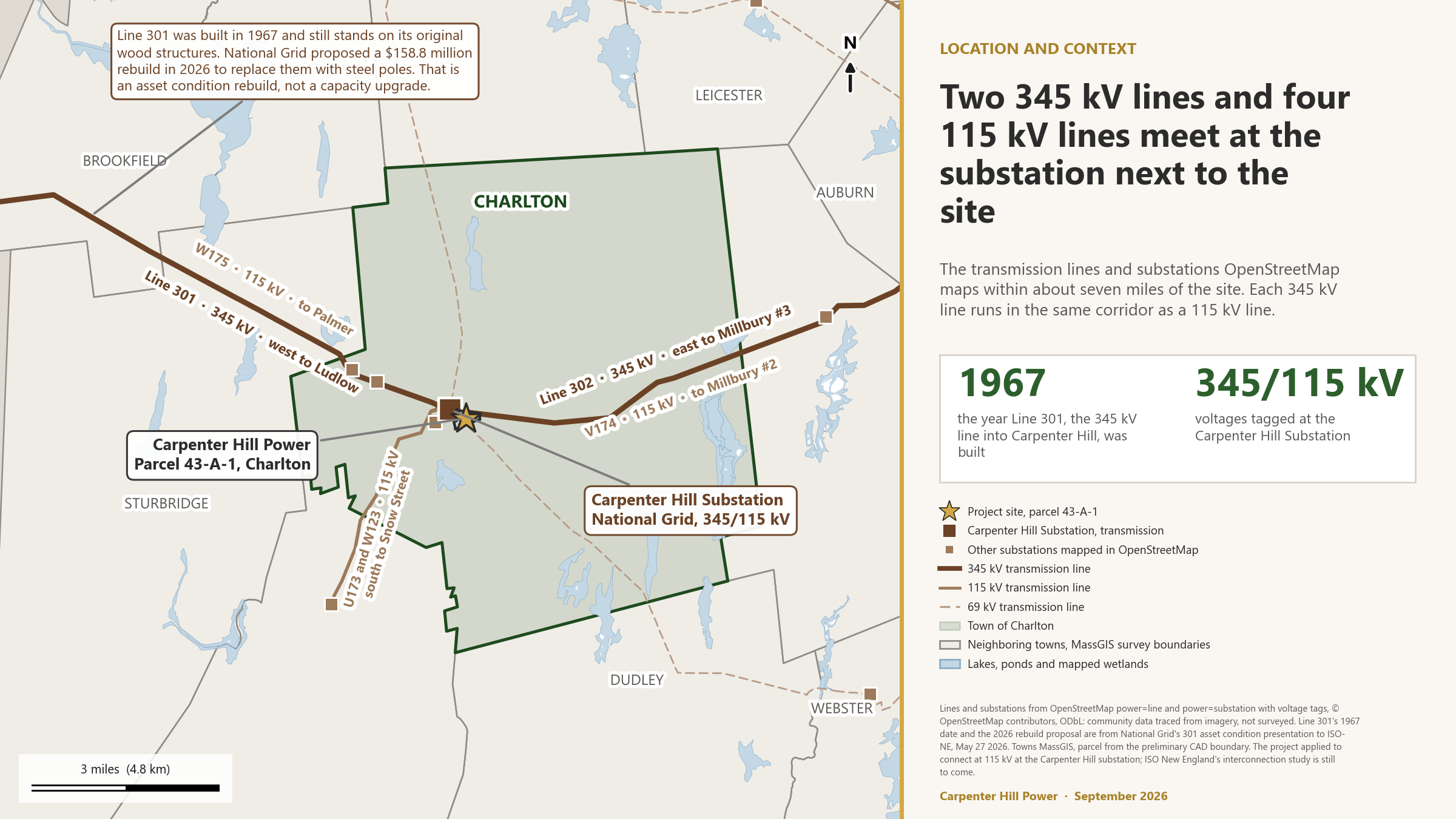
Charlton was not chosen so much as the Carpenter Hill Substation was. The 345 kV and 115 kV transmission lines meet there, and it connects eastern and western Massachusetts. We described it as an interchange on a highway, where voltage can be stepped up or down to serve the region. Battery storage fits best at a substation like this one. When we find a suitable substation, we reach out to the surrounding landowners to see whether any are willing to lease land to host a project.
Why not Springfield, an industrial site, or somewhere else?
ESA has looked at essentially every substation in ISO New England, the region's grid operator, with a focus on Massachusetts, where electricity demand is highest and growing the most. A site has to meet three tests: a substation that can support storage, land that can actually be built on (many sites are wetlands or otherwise unbuildable), and a landowner who is willing to lease. Very few sites passed all three. ESA has site control at other substations as well. At others, another developer already had site control of the available land.
Website and email draft; source answers as of October 7, 2026
Who decided this was needed?
ESA did. We start by looking at the grid. When electricity prices swing up and down, that signals a need for storage to smooth them out. We are all part of one New England grid, so that need is regional. The substation here is also close to where the power lines already are, so it needs very little new infrastructure.
Was this picked as the best and safest site?
The site was identified because of the interconnection point and a willing landowner. For battery storage, the best location is one next to existing transmission infrastructure, which is why this site works. Safety comes from proper permitting and planning: the studies and the state review decide whether it is safe and suitable. A preliminary Site Suitability Analysis is published now at https://carpenterhillpower.com/reports/site-suitability, along with a preliminary Cumulative Impact Analysis. The hydrology and stormwater studies, the sound study, and the gas plume analysis are committed, and an independent reviewer the town selects will review the Emergency Action Plan. The state's Energy Facilities Siting Board then reviews the project in public hearings and can approve it, attach conditions, or deny it.
Corrected November 17, 2026, from the earlier published response
Charlton already has solar, a power plant, gas storage. Why add this?
Each project is considered on its own merits, and we take cumulative burden into account. It is high for this census block. Storage is different from solar: it does not produce new power, but makes more efficient use of power already on the grid.
How did the site score on the state suitability tool?
There is no single score. The tool looks at several criteria, and the results are provisional until it is re-run on the full area. Two points matter most: there is no farmland within the project footprint, and the main tradeoff is trees, which store carbon and provide habitat. We are looking at clearing fewer trees or adding habitat elsewhere.
Were the road and utility upgrades done for this project?
No. National Grid planned and carried out those upgrades for future use, and not for this project. National Grid does have to approve our connection, and it studies whether we can connect safely under its standards.
Who benefits financially from this location, and who carries the risk?
The landowner benefits through a lease agreement. ESA and the project's eventual owner benefit if the facility is built and operates. The town receives tax revenue or a PILOT, a negotiated payment in lieu of taxes. The project also includes a Community Benefits Plan developed with residents.
Website and email draft; source answers as of October 7, 2026
The project 12 questions
What exactly is being proposed?
A 150 megawatt battery energy storage system with about 600 megawatt-hours of storage, which is about four hours at full output. The latest design uses 136 battery units, down from 156 in an earlier design. It stores electricity from the grid and sends it back. It does not generate any power, and there is no solar or gas. It is not backup power for homes in an outage. It adds capacity to the grid, which matters most when supply is tight, such as during major storms or peak demand, and it helps keep voltage and demand steady.
Corrected November 17, 2026, from the earlier published response
How much land, and how much is cleared?
The equipment area would be about 5 acres, fenced, inside a leased area of about 15 acres on a 47-acre parcel. The project will clear no more than 10 acres of trees outside National Grid's transmission right-of-way, where the driveway and interconnection line run (page 21). The project is 150 megawatts, or 600 megawatt-hours, about four hours of storage.
Corrected November 17, 2026, from the earlier published response
Is this a data center, or could it become one?
No, this is not a data center. Carpenter Hill Power is a battery storage facility. It stores electricity from the grid and releases it when demand is high. It does not generate power or burn fuel. The equipment has control and monitoring systems, but it does not host computing or data storage for anyone else.
Existing FAQ draft; source answers as of October 2026
Is this treated like a power plant?
A battery storage system stores electricity from the grid and sends it back when demand is high. It does not produce new power. It makes more efficient use of power already on the grid. State rules treat it as a clean energy infrastructure facility, a category separate from power plants. Specifically, it is a Large Clean Energy Storage Facility, which means an energy storage system of 100 megawatt-hours or more. The state's Energy Facilities Siting Board will review the project and decide whether to approve it.
Corrected November 17, 2026, from the earlier published response
Who is behind this project, and who is paying for it?
Carpenter Hill Power, LLC is developed by ESA, an independently owned solar and energy storage company based in Central Florida. ESA has said the project will be sold to a long-term owner and operator. ESA pays the cost of early-stage development, and that cost is folded into the price of the project. We have not published other financing details.
Existing FAQ draft; source answers as of October 2026
Is this project subsidized?
The consolidated answer is being reviewed. Earlier responses remain available in the submission history.
Is it leased land, or will ESA buy it?
The project is planned on leased land, not purchased land. Lease terms are not published.
What does it cost, and what will you sell it for?
Building the project will cost roughly $200 million to $300 million. ESA creates value by developing and permitting the site, which represents a small fraction of that total cost. The future buyer will purchase the permitted project before construction begins.
What kind of owner buys it, and how does it make money?
An owner could be a utility, an infrastructure fund, or an energy company. We cannot name any, because none has been selected. Owners earn money in three main ways: charging the battery when power is cheap and selling it when power is expensive, payments for being available as capacity when the grid needs it, and services that keep the grid balanced second by second.
Could the project grow?
The current proposal is 150 megawatts. Under state rules, the project must tell the Energy Facilities Siting Board about any change beyond minor variations, and the Board decides what further review is needed.
Corrected November 17, 2026, from the earlier published response
How long do the batteries last, and are they recycled?
The facility is planned for an operating life of 20 to 35 years. The batteries use lithium iron phosphate, which has no cobalt or nickel. Recovery rates vary by component and processor, and the recycling industry is likely to look different when the facility is decommissioned. A decommissioning plan is required and is filed with the application, covering removal and disposition. Verification of the final disposition of the batteries will be built into the decommissioning conditions. The decommissioning bond is posted before construction.
Website and email draft; source answers as of October 7, 2026
How much power does it store in a year?
We have not modeled this yearly figure yet. The yearly figure depends on our ongoing interconnection study. This figure is proprietary and is not published.
Corrected November 17, 2026, from the earlier published response
Meetings and staying informed 12 questions
When is the next public meeting? Will it be longer, elsewhere, with experts?
We heard three requests on September 30: a technical person who can answer water, noise, and fire questions, meetings longer than an hour and a half, and a different venue. We took all three on board. The third public meeting follows the Community Benefits Plan comment period, which has been extended into 2027. The date and place will be mailed and posted at least a month ahead. Before then, the Citizen Advisory Committee meets on Thursday, December 10, at 5:00 PM on Zoom to go over the comments received. Everyone is welcome.
Can I talk with the team live?
Yes. Virtual office hours run on Zoom on Wednesdays from 1:30 to 2:30 p.m. Eastern. They are on break for Thanksgiving week and the week after, and the next sessions are Wednesday, December 9, and Wednesday, December 16. After that they break again for the holidays, and we will email in January with the next chance to meet. Join by computer, phone, or tablet, and no RSVP is needed. The link and dial-in numbers are in our project emails, and Jonathan Santiago can send them to you. In the meantime, you can call or email him any time, jsantiago@esa-solar.com or 407-232-7440 ext. 251, or comment on the draft Community Benefits Plan.
Updated response, November 2, 2026
Where can I find meeting recordings, slides, and written answers?
Recordings of both September 30 sessions, the meeting slides, and the session summaries are in the engagement log. Written September 30 answers are in the Document Library.
How fast will you answer my comment?
Use the comment form on carpenterhillpower.com, or email or call. Every comment gets a response within 10 business days, and written proposals to change the draft Community Benefits Plan are answered in writing within 30 days. What we heard and what we did is posted in the engagement log. Comments on the draft Community Benefits Plan are open into 2027, and the closing date will be posted at least three weeks before comment closes.
Corrected November 17, 2026, from the earlier published response
Where is the Participate link?
Select Participate in the menu at the top of carpenterhillpower.com. It goes to the Participate section of the homepage, which has the email sign-up, the comment form, and advisory committee information.
Website and email draft; source answers as of October 7, 2026
How do I join the Citizen Advisory Committee? Who is on it?
Membership is open to anyone who accepts the responsibilities in the committee's charter. Email jsantiago@esa-solar.com and say you are interested in the advisory committee. Every meeting is open to anyone who wants to attend.
Corrected November 17, 2026, from the earlier published response
How do I get updates by email?
If this reached you by email, you are already on the list and getting updates. To sign up someone else, or yourself if you read this elsewhere, use the sign-up form on the Participate page of carpenterhillpower.com. If the form does not work, email jsantiago@esa-solar.com or call 407-232-7440 ext. 251 and ask to be added. We have committed to send project updates at least quarterly.
Existing FAQ draft; source answers as of October 2026
Where can I find more detail?
The Document Library has maps, the site plan, safety reports, and the draft Community Benefits Plan. The engagement log shows what we heard and what we did at every meeting. The Commitment Tracker lists every promise and its status. Some studies are still underway, and we publish results as we get them.
Existing FAQ draft; source answers as of October 2026
I am a reporter or researcher.
Email jsantiago@esa-solar.com or call 407-232-7440 ext. 251. Media and research requests go to the same contact.
Existing FAQ draft; source answers as of October 2026
My email to the project went unanswered.
This needs an individual response based on the original message and the circumstances of the property or person.
How do I RSVP, get a meeting link, or confirm the time?
Meeting dates, times, and places are on the events calendar on the homepage of carpenterhillpower.com. In-person meetings do not have an online link. For virtual meetings and office hours, the link, meeting ID, passcode, and call-in numbers are in the project emails. To RSVP, get a link, or confirm a time, email Jonathan Santiago at jsantiago@esa-solar.com or call 407-232-7440 ext. 251.
Will the project use a Facebook page?
The suggestion is recorded. Project information is currently shared through carpenterhillpower.com, the project email list, mailers, public meetings, and weekly virtual office hours.